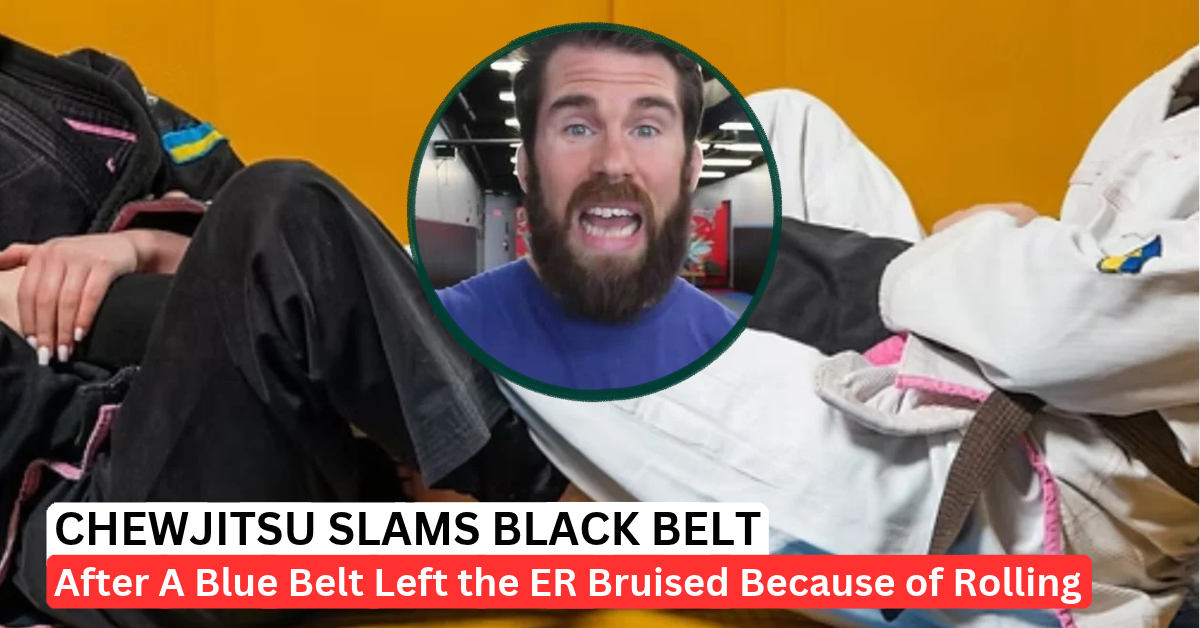
- A viral Chewjitsu video is circulating in which a black belt injures smaller female blue belt during rolling — and the coach’s verdict is blunt: that shouldn’t happen.
- The account comes from “A,” a 30-year-old blue belt around 125 lb and 4’11”, and it is unverified — no gym, no black belt, and no student are named.
- Chewjitsu’s real point is size mismatch BJJ and intensity control, not rank: a skilled, larger higher belt can control their pressure.
- His practical advice is to shop gyms, observe the culture, ask about female participation, and talk to coaches before committing.
- No verdict is passed on anyone here — the value is the gym-culture question the anecdote raises.
Nick Albin — the coach the Jiu-Jitsu internet knows as Chewjitsu — has built a channel on answering the questions grapplers actually send in. This week one of those questions cut close to the bone. A 30-year-old female blue belt, identified only as “A,” wrote in describing a gym where she was consistently the smallest person on the mats and where, by her account, a much larger male black belt put enough pressure on her during rolling to send her to the emergency room.
What Chewy Actually Said
In the video, Chewjitsu reads A’s message aloud while protecting her identity. She describes herself as around 125 lb and 4’11” — small, as the coach notes — and says the larger men she rolls with do not take it easy on her and can be dangerous at times.
In one incident, A says a black belt held her under heavy knee on belly pressure. The pain was severe enough that she went to the ER believing she had appendicitis. By her account, doctors ruled that out and told her she was badly bruised.
A also described submissions being ripped, dangerous behaviour being common, and a coach who, she said, did little when she raised it. Her question was blunt: does a gym where people actually follow rules and do not injure everyone exist at all?
If people are getting injured left and right and you’re like a 125 lb female who’s a blue belt, and you’re getting crushed by somebody and you said your injury came from a black belt — that shouldn’t happen.
–Chewjitsu –
The coach does not treat A’s account as settled fact. In his words, he does not know her personally, so she could be lying to him — but on the face of what she described, the environment sounds unsafe, and he would not want to train in a place like that.
When A Black Belt Injures Smaller Female Blue Belt, It’s Size And Intensity Control — Not Rank
The injury matters precisely because of the black belt’s skill, Chewjitsu argues — not because rank proves anything, but because a skilled, larger higher belt can and should manage what they do to a smaller body.
If you’re a skilled higher belt who’s larger, you can very easily control your pressure and make sure you don’t hurt anybody. I’ve never hurt one of our ladies, not once.
–Chewjitsu –
Accidents happen in grappling, he concedes, but they should be rare, not routine. The line he draws is between a one-off and a gym where injuries seem to be happening all the time.
The recurring issue here is not gender and not really rank — it is the size mismatch BJJ teaches you to manage. A 125 lb blue belt rolling with a much bigger training partner is always going to be vulnerable to top pressure.
That is intensity control: knowing the difference between pressure that teaches and pressure that injures, then applying it accordingly. Learning to be safe on the mats starts with that awareness.
Coach’s Advise: How To Choose A Safe BJJ Gym
Chewjitsu’s answer to A’s real question — how to choose a safe BJJ gym where people abide by the rules and do not injure everyone — is a checklist, not a verdict.
Go around to the gyms in your area, he says. Most offer a trial class or a trial week. Get a feel for the environment and look for other women training there.
Talk to the coaches and tell them what you are dealing with and what you are looking for — because some rooms are full of young competitors chasing an ADCC title, which may not be the place for you, while others run hardcore classes, easier classes, and dedicated women’s classes.
Go check around and find what’s available to you, and don’t commit to anything yet.
–Chewjitsu –
Choosing the right room matters because who you train with determines how safe you stay and how much you improve.
Whose Job Is Partner Safety? The Gym Culture Question
The video has restarted a conversation that is not new on the mats: whose job is it to keep a smaller grappler safe? The consensus among grapplers, female and male alike, has largely landed on the same answer Chewjitsu gives — this is about size and control, not a gender war.
For smaller grapplers the practical takeaways are concrete: you can decline a roll, ask for positional rounds, and choose partners you trust. Mat awareness is a skill you build, too. But the coach’s responsibility is the heavier one. A culture where bad partners face no consequences is a room problem, not a student problem.
None of this names a gym or a person, and it does not need to. The value of the story is the question it forces: when a black belt injures smaller female blue belt and nobody checks it, the problem is the environment, not the belt.
At its core, women’s BJJ safety — and safety for every smaller grappler — starts with coaches who set the standard and partners who take care of each other’s bodies. Chewjitsu closes with the rule he calls the golden rule of grappling: he will take care of your body the way he wants you to take care of his.