

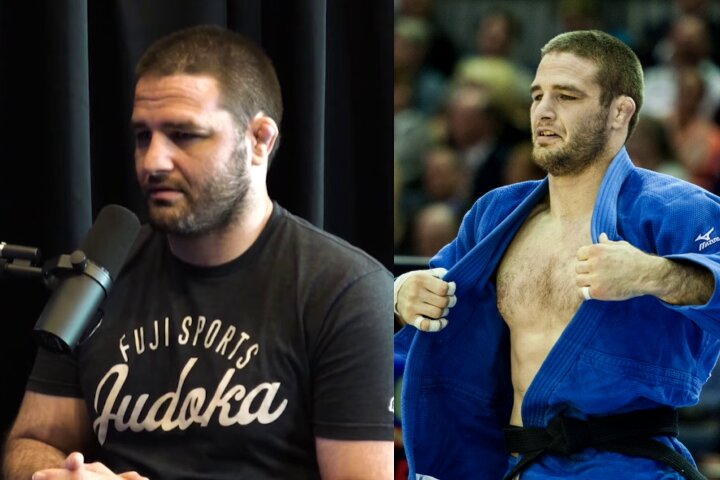
Olympic silver medalist Travis Stevens says chasing the leanest possible physique works against judo players.
On a podcast, he argued that body fat acts as protection for athletes who get thrown repeatedly:
When athletes get really lean, like I see a lot of athletes work towards like the 1%, 2% body fat as like a, I’m ready to go…
But in combat sports, you really want that to be around like 6 or 7%, because we need the cushioning in our body to handle the impact.
His view came from managing his own weight. Between the 2012 London Olympics and the 2016 Rio Olympics, his walking weight rose from about 189 pounds (86 kg) to roughly 194-196 pounds (88-89 kg), while he still competed at 178 pounds (81 kg).
His nutritionist eventually recommended moving up to 198 pounds (90 kg) because staying at 178 had become unhealthy, but the timing made it impossible:
I’m like – you’re not jumping to 90 kg, qualifying the weight class in eight months and then going to compete in the Olympic Games.
So I had to hold off that weight, but the plan was to always go 90 kg after 2016.
He is just as skeptical about elaborate diets, calling nutrition a “total waste of time” for most athletes.
Judo players spend nine months of the year on the road, living in hotels with no kitchens. So when a U.S. Olympic Committee nutritionist presented an elaborate plan, he pushed back:
If you can’t write me a nutrition plan that lets me eat out of a 7-Eleven, it’s a total waste of my time… We don’t have the utensils.
We’re stuck with whatever the IJF gives us on tour or whatever the restaurant food is – and that’s assuming there’s even a restaurant by your hotel.
For Stevens, mindset beats precision:
A happy athlete is a dangerous athlete on the tatami… Give me a cheeseburger and a Diet Coke. And when we go do judo, your salad is not helping you.
This comes down to the judo, not your salad.
Sloth Jiu-Jitsu: The Ultimate Guide for Calmly Beating Bigger, Younger Opponents
💥 What if slowing down was the fastest way to win?
💭 Tired of Getting Smashed by Younger, Stronger Grapplers?
It’s not your age. It’s your strategy.
If you’re a passionate grappler over 35 who’s sick of getting outpaced, outmuscled, or out-cardio’d by opponents half your age — this 120 page e-book was made for you.
🔓 Unlock the Power of Sloth Jiu-Jitsu:
Build Sustainable Strength—Without Wrecking Your Joints, Energy, or Jiu-Jitsu
Tired of waking up sore and burnt out after lifting?
Sloth Strength is a proven blueprint for grapplers over 35
who want to get stronger—without the pain, burnout, or injuries.
Developed from 25 years on the mats, this no-burnout approach is made
specifically for BJJ athletes in their 30s, 40s, and beyond.