

Summary
The long guard is one of Muay Thai‘s most versatile and tactically intelligent defensive tools, a technique that does far more than simply protect against incoming strikes. By extending the lead arm forward and positioning the rear hand to cover the chin and body, the long guard creates distance, controls the pace of a fight, disrupts an opponent’s offensive rhythm, and simultaneously sets up a wide range of counters including elbows, teeps, knees, hooks, and sweeps. Used correctly, it transforms a defensive position into an offensive launchpad. This article covers everything you need to know about the long guard: the basic stance and hand positioning, what situations it is best suited for, how to use it defensively, offensively, and as a counter tool, how to drill it effectively in shadowboxing, bag work, and sparring, and the most common mistakes that undermine its effectiveness. As Muay Thai World Champion and Evolve MMA instructor Chaowalit Jocky Gym puts it, “The long guard is not just a way to survive — it is a way to take control. When you use it correctly, you are not waiting for your opponent to stop attacking. You are making them stop, and then you are punishing them for having attacked in the first place. That is the difference between defence and strategy.” Whether you are new to Muay Thai or looking to add a more sophisticated defensive layer to an established game, the long guard is a technique that will repay serious study.
Key Takeaways
- The long guard is simultaneously a defensive tool and an offensive setup. Its primary purpose, creating distance between you and an aggressive opponent, is only the beginning. From the long guard, you have access to elbows, teeps, knees, hooks, and sweeps, making every defensive position a potential counter-attack opportunity.
- Distance control is the long guard’s most fundamental benefit. By extending the lead arm, you push your opponent to the edge of their effective striking range while keeping yourself in a position to counter. Every technique built on the long guard depends on this distance advantage being maintained.
- The long guard is most effective against aggressive, forward-pressing opponents. Its ability to absorb, deflect, and redirect forward momentum makes it a natural answer to opponents who charge in with combinations — turning their aggression into your opportunity.
- Combining the long guard with a reverse shuffle multiplies its effectiveness. Using the long guard in place is useful in tight spaces like the ropes, but pairing it with backward and lateral movement creates sustained distance that prevents the opponent from simply walking through it.
- Variety in your long guard positions is essential to preventing opponents from picking it apart. Relying on a single variation, both hands extended, rear hand close to the face, or the Dracula guard, gives opponents a pattern to exploit. Mixing variations keeps your defence unpredictable and harder to overcome.
- Sparring is the only training method that develops a functional long guard. Shadowboxing and bag work build the mechanics and the muscle memory of the transition, but only sparring against resisting opponents develops the timing, the counter selection, and the positional awareness that makes the long guard work under real pressure.
Basic Stance And Hand Positioning
In its simplest form, the long guard has two hand components: the front and rear hand positions. The guard can be performed from either an orthodox or a southpaw fighting stance.
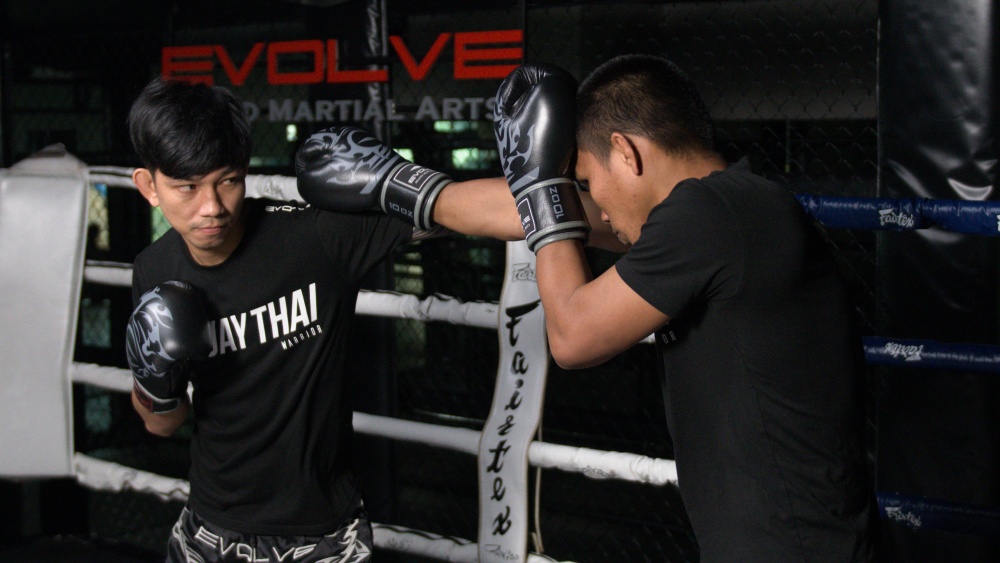
Moving into the long guard from a shell guard, the lead hand is extended forward, with the arm fully stretched out and the hand at eye level. The rear hand is also extended out and away, but closer to the face and body, providing additional protection for the chin and midsection. You won’t be standing waiting in this position, but once your opponent moves then you will transition into it.
What The Long Guard Is Good For
When you’re fighting an aggressive forward-charging opponent and you need to create some space, this is the perfect time to go into the long guard. By creating space, you can utilize footwork and angles to avoid kicks and punches as well as set up for countermoves.
You will either initiate the long guard in place, for example, if you’re up against the ropes, or you will simultaneously use it along with a reverse shuffle. Creating distance between yourself and your opponent will be an ongoing theme with the long guard.
One strategy in a fight is about setting up your opponent, moving through their defense, and initiating an offensive move to either score points or knock your opponent out. The long guard can be used both defensively and to set up an offensive attack.
Defense, Offense, And Countering From The Long Guard
The Muay Thai long guard can be an effective defensive tool, but it can also be utilized for offense and counterattacks. From the long guard, teeps and elbows can be thrown either as a counter or when your opponent closes in on you.
Defensively, the long guard can be used to keep an opponent at bay, preventing them from closing the distance and landing strikes. It can also be used to block straight punches and hooks by using the lead arm to absorb the impact of the strike. Additionally, the rear hand can be used to block body shots, as well as trap kicks and set up sweeps.
Combining the long guard and a reverse shuffle keeps your opponent at a distance, this is particularly effective and useful against an aggressive puncher. It is easier to deflect or parry punches from the long guard.
The Muay Thai long guard is a highly effective defensive tool against various strikes, including the left hook, left body hook, and straight punch. By extending the lead arm, you can keep your opponent at a safe distance and block incoming strikes with your rear elbow, while also keeping your lead arm up to cover your chin.
This technique not only defends against the opponent’s attacks but also creates opportunities for you to counter with powerful elbow strikes from either arm. The long guard is a versatile technique that is useful in both defensive and offensive situations.
In addition to its defensive capabilities, the Muay Thai long guard can also be used for offensive moves. For example, you can use the long guard to pull down your opponent’s lead arm, leaving their head open for a lead hand hook or a vertical elbow strike.
You can also use the long guard to set up knee strikes by pulling your opponent’s arms down and stepping in. From the long guard position, you have the option to throw various strikes such as shuffle jabs, straight right crosses, uppercuts, elbows, kicks, and knees, allowing for a diverse range of attacks.
Practicing The Long Guard
Master the long guard through consistent shadowboxing, bag work, and sparring to improve transitions, defense, and counterattacks.
Practicing is essential to mastering a technique, and the long guard is no different. You will need to utilize every opportunity to play with the long guard and make it part of your box of tools.
Here’s how you can practice and drill the long guard:
- Shadowboxing: You can work on the transitions into the long guard while you are shadowboxing. While practicing your footwork, practice getting into the long guard.
- Heavy Bag Work: Using the heavy bag to add some resistance to your lead hand will help with entering the long guard under a bit of pressure. Push the bag and on its return use the lead hand to stop the bag.
- Sparring: This will be by far the best way to practice the Muay Thai long guard. While you are sparring you can incorporate it into your defense and practice the counters as well.
Sparring will allow you to work through the different guards and blocks that you can use from the long guard. Parrying, deflecting, catching a leg, moving in for a clinch, and a throw can be done for the long guard.
Common Mistakes
The biggest mistake of any defense is to only have one to rely on. Even if the long guard is one of the go-to defense techniques in Muay Thai, it is very important to understand and use the different variations to keep from getting your defense picked apart and eventually having it compromised.
You are going to need to use the long guard in all of its variations during a fight. Both hands extended, the rear hand closer to the body, the Dracula guard, or any one of the varying rear hand positions that you can use to guard.
Frequently Asked Questions About The Muay Thai Long Guard
Q: What Is The Muay Thai Long Guard And How Does It Differ From Other Guards?
A: The long guard is a defensive position in which the lead arm is fully extended forward at eye level and the rear hand is positioned closer to the face and body. Unlike the high guard, where both hands are held close to the head, the long guard actively uses the extended lead arm to create and maintain distance, push back the opponent, and disrupt their ability to close the gap and land strikes. Unlike the teep, which creates distance through a kick, the long guard creates distance through arm extension and can be held continuously as a positional tool rather than used as a single strike. Its defining characteristic is that it is both a passive defensive tool and an active offensive setup simultaneously.
Q: When Is The Best Time To Use The Long Guard In A fight?
A: The long guard is most effective when facing an aggressive, forward-pressing opponent who relies on walking you down and landing combinations at close range. The moment an opponent begins to close the distance with committed forward pressure is the clearest trigger to transition into the long guard — either in place if you are already near the ropes, or combined with a reverse shuffle to create sustained distance. It is also effective when you have been caught in a corner or along the ropes and need to create space to reset your position. Less experienced fighters often use it reactively; more experienced fighters learn to anticipate pressure and transition into the long guard proactively, before the opponent has fully committed.
Q: What Counters Are Most Effective From The Long Guard Position?
A: The most natural and immediately available counter from the long guard is the teep — the extended lead arm and the push kick share the same distance-creating purpose and can be combined fluidly. The lead elbow is the most dangerous close-range counter available from the long guard, particularly when the opponent has successfully closed the distance despite your extended arm. The shuffle jab can be thrown from the long guard to close distance suddenly and catch opponents who are trying to circle out. Knee strikes become available when you use the lead arm to pull the opponent’s arm down and step into clinch range. The rear cross is available as a straight counter when the opponent’s guard is occupied by your extended lead arm. Each counter exploits a different reaction the opponent might have to the guard itself.
Q: How Does The Long Guard Help Against Kicks As Well As Punches?
A: Against kicks, the long guard’s primary function is positional rather than direct blocking. By maintaining distance through the extended lead arm, you force kicks to travel further to reach you, which reduces their power and gives you more time to check, catch, or step away. The rear hand position in the long guard, closer to the body, can be used to catch incoming body kicks and set up sweeps, which is one of the long guard’s most effective offensive applications. Against the inside leg kick in particular, the footwork naturally associated with the long guard — the reverse shuffle and lateral movement — disrupts the opponent’s angle and timing before the kick is even thrown.
Q: What Is The Dracula Guard And How Does It Relate To The Long Guard?
A: The Dracula guard is a variation of the long guard in which the lead arm is extended and the rear hand is held near the face with the forearm covering the chin, resembling the way Dracula holds his cape across his face. It provides the same distance-creating function as the standard long guard while offering enhanced chin protection from the rear side. It is most useful against opponents who throw heavy rear-hand counters in response to the extended lead arm, as the rear forearm position intercepts those counters more reliably than a hand held further from the face. The Dracula guard is one of several rear-hand variations mentioned in the common mistakes section of this article — understanding when to use each variation based on the opponent’s counter tendencies is part of developing a truly functional long guard.
Q: How Long Does It Take To Develop A Reliable Long Guard For Use In Sparring?
A: The basic mechanics of transitioning into the long guard can be learned relatively quickly — most practitioners can drill the movement and understand the hand positioning within their first few sessions of focused work. Developing the timing to transition into the long guard at the correct moment in sparring, and the counter selection to exploit the positions it creates, takes considerably longer — typically several months of consistent sparring application. The long guard is a technique that reveals its full depth gradually: each sparring session exposes new timing windows, new counter opportunities, and new situations where it is and is not the right tool. Approach it as a long-term project rather than a technique to master in a single training block.
Q: Can The Long Guard Be Used Effectively By Beginners Or Is It An Advanced Technique?
A: The long guard is accessible to beginners and worth introducing early in training, but its full range of applications, the counter selection, the positional adjustments, the sweep setups, and the elbow counters develop with experience. Beginners benefit most from learning the basic transition into the long guard and the reverse shuffle combination, as these two elements alone provide immediate practical value against aggressive opponents in sparring. The offensive applications of the long guard, pulling the arm to set up an elbow, transitioning into a knee, using it to trap a kick, are better introduced once the defensive foundation is solid and the beginner is comfortable holding the position under pressure without abandoning it at the first sign of contact.
Q: How Does Using Multiple Long Guard Variations Prevent Opponents From Exploiting It?
A: A single, predictable long guard variation gives opponents a fixed target to work around. If your lead arm is always in the same position at the same height, an experienced opponent will learn to go under it, around it, or time a response to it that bypasses the guard entirely. Mixing variations — both hands extended, rear hand closer to the body, the Dracula guard, different rear hand heights — forces opponents to solve a different defensive problem each time they attempt to close the distance or throw a combination. This unpredictability is what makes the long guard genuinely difficult to overcome rather than just temporarily effective. The goal is to make your opponent uncertain about where your hands will be each time they attack, which is exactly the condition that creates counter-attack opportunities.
Final Thoughts
The long guard is a technique that rewards fighters who take the time to understand it properly. On the surface, it appears to be a distance-management tool — a way of keeping aggressive opponents at arm’s length. But the deeper you study it, the more its offensive potential becomes clear: the elbow that fires when an opponent walks into your extended arm, the teep that flows naturally from the same position, the knee that follows when you use the guard to pull the opponent in, the sweep that becomes available when you catch a kick with the rear hand.
This is the quality that distinguishes the best defensive techniques in Muay Thai from merely adequate ones. They do not just protect — they create. Every time an opponent engages with your long guard, they are exposing something, and a fighter who has drilled the counters thoroughly enough to recognise and exploit those exposures automatically has turned their defence into one of their most dangerous offensive weapons.
Drill the transitions. Develop the counter selections. Bring it into sparring with a specific intention in each round. The long guard will repay that investment in ways that become clearer every time you use it.
You may also like:
Essential Solo Muay Thai Drills For All Levels