

- BJJ treats rank as permanent—until a coach says otherwise. There is no universal governing body with the authority to revoke a belt
- Three distinct layers determine belt validity: the coach who awarded it, federation certification (IBJJF), and social acceptance by the community
- IBJJF does not issue belts but certifies black belts and maintains membership categories—the federation states that athlete points are not affected by changing academies
- Real cases exist of coaches demoting students, including a publicly documented brown-to-blue belt demotion
- BJJ black belt revoked – could it happen legitimately?
Belt colors in Brazilian Jiu-Jitsu carry emotional weight disproportionate to their material value. A strip of fabric can represent a decade of training, and losing it can feel like losing part of your identity.
Stories of belt demotion BJJ cases surface regularly in online communities: a coach demoting a student who left for another academy, a public stripping of rank for misconduct, or the more ambiguous case of a student whose former coach refuses to acknowledge their current rank. The question of the authority to get a BJJ black belt revoked sits at the center of these disputes.
The question “Can a BJJ black belt be revoked?” is more complex than it seems. There is no single authority in BJJ that controls rank across all academies. Unlike a driver’s license or medical license—which a government or board can suspend—a BJJ belt belongs to a decentralized system where the authority to award it comes from the individual coach, not an institution.
The Three Layers Of BJJ Rank
Understanding whether a belt can be revoked requires untangling three distinct layers: the coach who awarded it, the federation that certifies it, and the community that recognizes it.
The Coach-Granted Belt
The most fundamental layer is the relationship between student and instructor. When a coach promotes a student, they are making a public declaration that the student has reached a certain level of technical proficiency. Authority to promote comes from the coach’s own lineage and rank.
In theory, the same coach who awarded a belt could revoke it. There is no rule book preventing a coach from saying “I no longer consider you a black belt.” In practice, this creates an awkward authority dynamic—if the relationship between student and coach breaks down completely, the coach retains the nominal power to withdraw their endorsement.
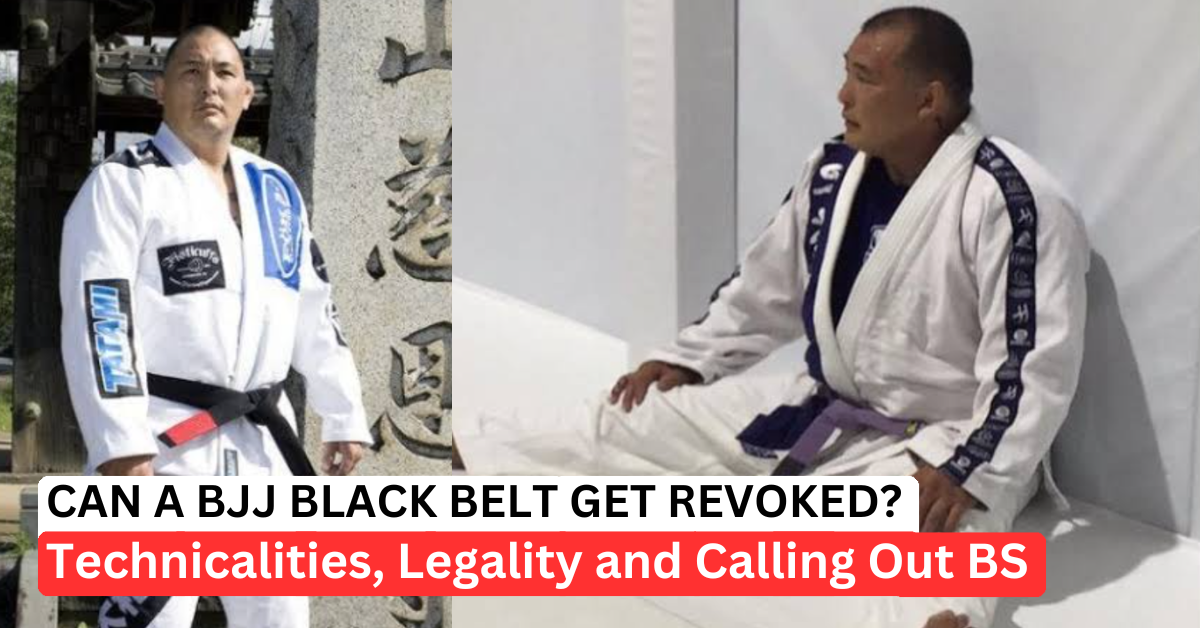
The most common scenario for coach-driven demotion is when a student leaves an academy under contentious circumstances. The BJJEE documented a case of a BJJ instructor demoting a student from brown belt back to blue belt after a dispute, releasing the footage publicly.
The demotion was based on the instructor’s claim that the student had not earned the rank in the first place—a subjective judgment that highlights how vulnerable rank can be when it depends on a single individual’s opinion.
IBJJF Certification
The IBJJF adds a second layer through its black belt certification program. The IBJJF does not issue black belts—it certifies them. When a coach promotes a student to black belt, the coach can register that promotion with the IBJJF, which then issues a certificate confirming the rank.
The distinction between certification and membership is important. The IBJJF black belt certificate is a one-time registration of the promotion. The IBJJF black belt membership, by contrast, is an annual subscription that must be renewed. Lapsing on membership does not affect the certificate or the rank itself—it simply means you are not an active IBJJF member.
The IBJJF’s athlete ranking information is revealing on this point. The federation explicitly states that “the athlete’s points are not affected by a change of academy or professor.” This is a meaningful acknowledgment that IBJJF considers rank—and the competitive points that go with it—to belong to the athlete, not the academy or coach.
Social Recognition
The third layer is the most fluid and, arguably, the most durable. Once the community accepts you as a black belt—once you have taught, competed, and trained at that rank in front of peers—removing that rank becomes nearly impossible.
This is the fundamental tension in belt revocation. A coach can claim a student is no longer a black belt, but if that student shows up to an open mat at another academy and rolls at a black belt level, the community will recognize them as a black belt regardless. The social layer operates independently of the coach-athlete relationship.
This is why belt demotions are rare and controversial. They are attempts to reverse a social fact—once the community has accepted someone at a given rank, the attempt to demote them creates confusion and conflict.
When Belts Get Demoted — Real Cases
The most documented cases of belt demotion involve students who leave academies under circumstances that anger their former coach. The brown-to-blue demotion covered by BJJEE is the most visible example: the coach filmed the demotion, claiming the student had not earned the brown belt and was being returned to their “true” rank.
Online discussions on Reddit’s r/bjj reveal a pattern. Common scenarios include:
- Students who change academies and have their former coach publicly disavow their rank
- Coaches who feel a student was promoted too quickly by a previous instructor
- Cases involving misconduct where a coach wants to distance the academy from the individual
- Disputes over lineage or affiliation where rank becomes a political tool
The key pattern across these cases is that demotion attempts only work when the community accepts them. If a coach demotes a student but the student continues training at a higher rank elsewhere and the new academy accepts them, the demotion is effectively nullified.
@masonfowlerbjj Black belt gets demoted to purple belt #bjj #jiujitsu ♬ original sound – masonfowlerbjj
The IBJJF Position
The IBJJF’s policies suggest a deliberate hands-off approach to rank disputes. The federation certifies promotions that coaches report but does not investigate the validity of those promotions. If a coach removes a student’s promotion from the IBJJF system, that is a technical revocation of the certification, not the rank itself.
The athlete rankings page reinforces this: “The athlete’s points are not affected by a change of academy or professor.” This means that even if you leave your original academy, your competitive record and ranking points remain yours. The IBJJF treats competitive achievement as individual accomplishment, not academy property.
This creates an interesting scenario. A coach could theoretically tell the IBJJF to remove a student’s black belt certification from their system. But the student could then join a new academy, have their new coach register the same belt with the IBJJF, and the federation would process it. The IBJJF’s role is administrative recording, not authoritative gatekeeping of rank.
Can A Black Belt Actually Be Revoked?
The honest answer is: it depends on what you mean by “revoked.”
If you mean a coach publicly stating that a student is no longer a black belt, then yes—any coach can say this at any time. There is no higher authority to stop them.
If you mean having the IBJJF remove your certification, then yes—your original coach can request this, though the IBJJF’s policies on handling such requests are not publicly detailed.
If you mean being prevented from training at black belt level at a new academy, then no—most academies will evaluate you based on your demonstrated skill, not your relationship with a previous coach.
If you mean the general BJJ community ceasing to recognize you as a black belt, then effectively no—once you have trained and competed at that level, the social recognition layer is extremely difficult to reverse.
The most realistic answer is that a belt can be “revoked” in a technical or administrative sense but is practically very difficult to remove from the community’s perception. The longer you have trained at a given rank, the more resistant that rank becomes to revocation attempts.
What This Means For Practitioners
For black belts, the practical takeaway is straightforward: your relationship with your coach matters. Even if the community recognizes your rank, a coach’s public disavowal can create complications. Maintaining professional relationships and avoiding public disputes with your coach reduces the risk of being the next headline.
For brown belts and below, the same principle applies with additional nuance. If you are training for a promotion, the promotion only has the weight that your coach and community give it. Promotions from coaches with established lineages carry more social weight than promotions from coaches whose own credentials are unverifiable.
For coaches, the lesson is that belt demotion is a nuclear option that rarely achieves the desired result. Once promoted, the promotion exists in the community’s collective memory. Attempting to reverse it invites scrutiny of the coach’s judgment in making the promotion in the first place.
BJJ Black Belt Revoked?
The BJJ black belt revoked question has no simple answer, but the BJJ rank authority coach dynamic is the key factor. Technically a coach can revoke certification, but BJJ brown belt demoted to blue examples show that the community ultimately decides.
Understanding the IBJJF black belt certification rules helps clarify the distinction between federation records and real-world rank. Technically yes, but practically no—and the gap between those two answers is where the real story lives. BJJ’s decentralized structure means no single entity controls rank, which makes belts simultaneously permanent and fragile.
They are permanent because the community remembers, and fragile because the coach who awarded them can always take their endorsement back. Understanding can coach revoke BJJ rank requires understanding these three layers—coach, federation, community.