


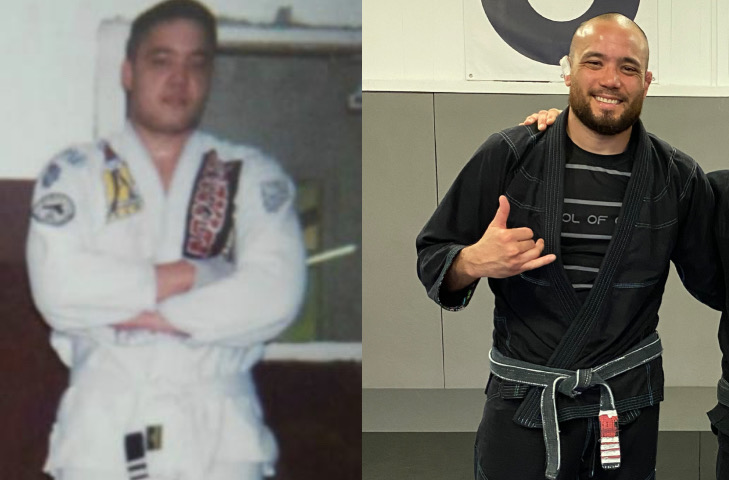
Written by Gile Huni., a 3rd degree BJJ black belt and head instructor at Kimura BJJ Serbia
Brazilian Jiu-Jitsu can become a surprisingly expensive lifelong pursuit.
A monthly academy membership might not look like much on its own. But train for 20 or 25 years and start adding gis, competition fees, flights, hotels, seminars, instructionals and injury treatment, and the numbers begin to look very different.
So how much does a 25-year BJJ career actually cost?
The honest answer is that there is no single number.
A recreational grappler training locally a few times a week and a serious competitor traveling internationally can spend radically different amounts of money.
Instead of pretending every black belt will spend the same amount, let’s break down the expenses that can realistically accumulate from white belt to veteran black belt.
1. Academy Membership: Potentially $30,000–$60,000+ Over 25 Years
For most practitioners, academy fees will be the largest unavoidable expense.
In the United States today, many BJJ academies charge roughly $120–$200 per month for unlimited adult training, although major-city and elite academies can exceed $200–$300 per month.
$100/month for 25 years: $30,000
$150/month for 25 years: $45,000
$200/month for 25 years: $60,000
Of course, this varies enormously by country. Training in Brazil, Eastern Europe or parts of Asia can cost considerably less than training in New York, Los Angeles or San Francisco.
There is another important caveat: this isn’t an inflation-adjusted historical calculation. Someone who started BJJ 25 years ago certainly wasn’t paying today’s membership prices for the entire period.
The figures simply show what a long-term training commitment can cost at different average monthly rates.
2. Competition Fees: From Almost Nothing to Tens of Thousands
This is where two BJJ careers can begin to look completely different.
A recreational practitioner who competes once every few years may spend very little. A dedicated competitor entering several tournaments every season can accumulate a substantial bill.
As a real-world reference, registration for major IBJJF tournaments can now exceed $100 per event. Athletes competing regularly in IBJJF events may also need an active annual membership.
If somebody averaged four tournaments per year at $125 each:
$500 per year × 25 years = $12,500
And that’s before transportation, hotels, food and other travel expenses.
Someone competing eight or ten times per year could obviously spend considerably more.
3. Travel: Potentially the Biggest Expense for Serious Competitors
Competition registration is often the cheap part.
Actually getting to the tournament can cost considerably more.
A local tournament might require nothing more than gas, parking and perhaps a meal.
An international tournament could mean airfare, several hotel nights, meals, taxis or rental cars and other expenses.
Someone competing primarily near home might spend only a few hundred dollars per year on BJJ-related travel.
A serious competitor traveling internationally several times per year could spend thousands annually.
Over 25 years, that difference becomes enormous.
This is why it isn’t credible to assign one universal “25-year travel cost” to every BJJ practitioner.
4. Gis, Rash Guards and Training Gear
BJJ equipment isn’t particularly expensive compared with some sports, but 25 years is a very long time.
A practitioner may go through dozens of gis over a career, along with rash guards, grappling shorts, belts, mouthguards, tape, knee sleeves and other equipment.
A typical mid-range gi today can cost roughly $100–$200.
If someone bought two $150 gis every year, for example:
$300 per year × 25 years = $7,500
Some practitioners will spend far less. Others who collect gis, train every day or regularly replace competition gear can spend considerably more.
And that calculation doesn’t even include No-Gi equipment.
5. Injuries: The Great Unknown
This is probably the hardest BJJ expense to predict.
Injuries are unquestionably part of the sport, but it would be misleading to assume that every long-term practitioner will undergo one, two or three major surgeries.
Research involving BJJ practitioners consistently identifies the knee as one of the most commonly injured areas, with meniscus, ACL and MCL injuries among the problems reported.
Research has also found that many BJJ injuries occur during training rather than competition, particularly during sparring.
But an injury does not automatically mean surgery.
For one athlete, 25 years of BJJ might involve occasional physiotherapy and relatively minor treatment.
Another practitioner could suffer an ACL reconstruction, shoulder surgery, herniated disc or another serious injury costing thousands of dollars.
The financial impact also depends enormously on where the practitioner lives. A surgery that creates a huge out-of-pocket expense in the United States might be largely covered by public healthcare or insurance elsewhere.
For that reason, medical costs shouldn’t simply be added as a fixed amount to everyone’s lifetime BJJ bill.
They are one of the biggest variables.
6. Seminars, Private Lessons and Instructionals
This category is frequently forgotten.
Over 25 years, many dedicated practitioners will attend seminars, buy instructional videos or pay for private lessons.
None of these expenses are mandatory, but for a serious student they can become significant.
Even spending an average of only $300 per year on additional BJJ education would equal:
$300 × 25 years = $7,500
For someone regularly buying instructionals, attending major seminars or taking private lessons, the figure could be considerably higher.
7. What About Food and Supplements?
This is where calculations of the “cost of BJJ” can become misleading.
Everyone has to eat whether they train Jiu-Jitsu or not.
It therefore doesn’t make sense to count someone’s entire grocery bill as a BJJ expense.
The same applies to general health supplements unless they are purchased specifically because of BJJ training.
A serious competitor might legitimately have additional expenses for protein, electrolytes, sports nutrition, recovery products or weight-cutting supplies.
Those are reasonable BJJ-related expenses.
But claiming that a practitioner spends $60,000–$120,000 on “healthy food” because of Jiu-Jitsu greatly exaggerates the actual cost of participating in the sport.
The meaningful figure would be the extra amount spent because you train BJJ, not the entire amount you spend feeding yourself.
So What Does 25 Years of BJJ Actually Cost?
There isn’t an honest universal answer.
But we can build a realistic example.
Imagine someone who trains consistently for 25 years and averages:
Academy membership: $150/month = $45,000
Gis and equipment: $300/year = $7,500
Tournament registrations: $500/year = $12,500
Competition travel: $1,000/year = $25,000
Seminars, instructionals and private training: $300/year = $7,500
That gives us:
$97,500 Over 25 Years
And that’s before medical expenses.
But this number needs context.
$97,500 is not the “average cost of becoming a black belt.”
It’s simply an example of what one committed practitioner following those particular spending habits would accumulate over 25 years.
A hobbyist who rarely competes, trains at an inexpensive academy and doesn’t travel for BJJ could spend dramatically less.
A serious international competitor who trains at an expensive academy, enters major tournaments, travels internationally several times every year and invests heavily in coaching could spend considerably more.
And there is another interesting way of looking at that $97,500.
Spread across 25 years, it’s approximately $3,900 per year, or $325 per month.
For someone whose main hobby, sport, social circle and competitive pursuit is Jiu-Jitsu, that puts the giant lifetime number into a little more perspective.
The Cost Nobody Calculates: Time
Money might not even be the biggest investment.
Consider somebody training four times per week for 25 years.
Even at only 90 minutes per session:
4 sessions × 1.5 hours × 52 weeks × 25 years = 7,800 hours on the mats.
Real life would reduce that somewhat because nobody trains every single week for 25 straight years without holidays, injuries or other interruptions.
On the other hand, serious practitioners often train considerably more than four times per week.
And none of this includes commuting to the academy, competitions, seminars, strength training, watching instructionals, teaching classes or simply all those hours spent thinking and talking about Jiu-Jitsu.
For a lifelong black belt, the time investment can ultimately dwarf the financial one.
And Yet, Would You Take Any of It Back?
Looking only at the final dollar amount misses something important.
Those thousands of dollars aren’t simply disappearing into a hobby.
They’re paying for thousands of hours on the mats.
They’re tournament weekends, road trips, flights across the world, new friendships, brutal training sessions, victories, defeats, promotions, injuries, comebacks and all the strange experiences that accumulate when you stay involved in one martial art for decades.
By the time someone has been doing Brazilian Jiu-Jitsu for 25 years, it’s usually difficult to separate the money they spent on BJJ from the life they built around it.
A black belt isn’t expensive because of the piece of fabric around your waist.
It’s expensive because of everything that happened before you were able to wear it.
So here’s the real question: How much do you think you’ve spent on Jiu-Jitsu so far, and would you actually want to know the real number?
Sloth Jiu-Jitsu: The Ultimate Guide for Calmly Beating Bigger, Younger Opponents
💥 What if slowing down was the fastest way to win?
💭 Tired of Getting Smashed by Younger, Stronger Grapplers?
It’s not your age. It’s your strategy.
If you’re a passionate grappler over 35 who’s sick of getting outpaced, outmuscled, or out-cardio’d by opponents half your age — this 120 page e-book was made for you.
🔓 Unlock the Power of Sloth Jiu-Jitsu:
Build Sustainable Strength—Without Wrecking Your Joints, Energy, or Jiu-Jitsu
Tired of waking up sore and burnt out after lifting?
Sloth Strength is a proven blueprint for grapplers over 35
who want to get stronger—without the pain, burnout, or injuries.
Developed from 25 years on the mats, this no-burnout approach is made
specifically for BJJ athletes in their 30s, 40s, and beyond.