Gaschwald/Getty Images
The question of how long Mercedes-Benz has made tractors is not straightforward. One of the companies that was merged to form Mercedes-Benz in 1926 had produced tractors before they came together. In 1919, Benz released the Benz-Gaggenau tractor. Afterward, a new Mercedes-Benz OE tractor appeared in 1928, with just 100 examples made before it was dropped in 1935.
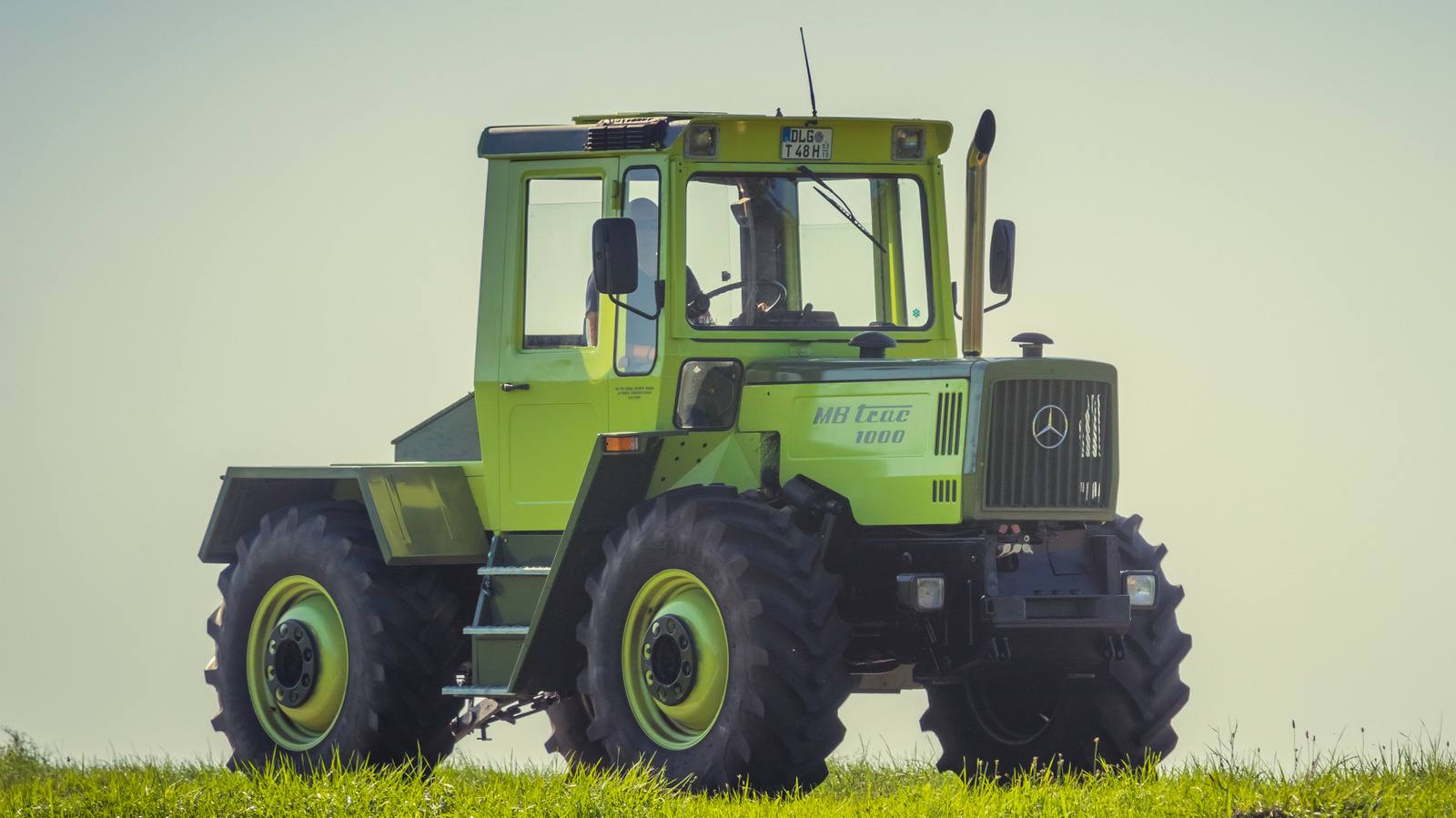
However, the modern history of Mercedes-Benz as a tractor maker begins in 1973, when the first MB-trac tractor rolled off the production line. The production-ready tractor had been shown to the world at 1972’s German Agricultural Society Exhibition in Hanover. The MB-trac shared many components with the Mercedes-Benz Unimog multi-purpose vehicle, one of the rarest Mercedes-Benz vehicles in the United States. While this permitted Mercedes-Benz to produce the MB-trac affordably at low production volumes, it also allowed the company to make a wide range of tractors that could perform a variety of tasks from light-duty work to heavy towing, including forestry and road construction duties.
The MB-trac tractor introduced a number of innovations to the tractor industry. It featured all-wheel drive as standard, with all four wheels being the same size, just like the Unimog. The cab’s central position let the MB-trac provide space for attachments on the front, the rear, or on the body itself, with hydraulic connections for balers or plows at the rear or the front. Production of the MB-trac continued until 1991, when it was discontinued because it was too expensive to make. Ford also stopped making tractors that year.
What else should you know about Mercedes-Benz tractors?
Koapan/Shutterstock
In 1980, Mercedes-Benz introduced a tractor to the market that would remain in the MB-trac lineup until production ended in 1991. This was the MB-trac 1500, which featured a Mercedes-Benz 5.7-liter OM 352 turbodiesel engine that produced 150 horsepower, a significant figure for its time. As Mercedes-Benz’ range-topping heavy-duty tractor until 1990, the MB-trac 1500 came equipped with air brakes, CAT III rear linkage, differential lock and four-wheel drive activated by air pressure, and suspension on the front axle as standard equipment. Options for the MB-trac 1500 included something unusual — the capability to drive the MB-trac 1500 in reverse while the driver looked forward, thanks to the dashboard and driver’s seat rotating 180 degrees.
Then in 1990, the title of top-of-the-line MB-trac tractor, in terms of power, went to the new MB-trac 1800 Intercooler (443 series), with a 6.0-liter six-cylinder turbocharged diesel engine fitted with an intercooler. Its output was 180 horsepower, with 14 forward gears plus reverse. The company produced the 1800 Intercooler from 1990 to 1991, the final two years of MB-trac production, ending 18 years after Ferruccio Lamborghini sold his tractor-making business. Fewer than 200 units of the MB-trac 1800 Intercooler were produced.
So the Mercedes-Benz Unimog remains as the foundation of the modern Mercedes-Benz tractor heritage story. The Unimog is still being made today for a variety of tough jobs that take it off the beaten path, including some that are agricultural in nature.