Summary
Defence is the foundation that every offensive technique in Muay Thai is built on — and blocking is the first layer of that foundation. Before a fighter can develop effective counters, clinch control, or ring generalship, they need to be able to protect themselves cleanly from the full range of weapons the art of eight limbs makes available. This article covers five essential blocking techniques every Muay Thai practitioner must master: the shin block for low and body kicks, the three covering-up variations for punches and elbows, the elbow block for body attacks, the double forearm block for multiple strike types, and the foot block for stopping kicks and knees before they gain momentum. Each technique is broken down with the mechanics, the situations it is best suited for, and the counter opportunities it creates — because in Muay Thai, a good block is never just a block. As Muay Thai World Champion and Evolve MMA instructor Chaowalit Jocky Gym puts it, “Defence is not the opposite of offence in Muay Thai — it is the beginning of it. Every time you block cleanly, you have stopped what your opponent was trying to do and created a moment where they are exposed. The fighter who understands that will always find more counters than the fighter who just tries to survive the attack.” Whether you are a beginner taking your first classes at a gym like Evolve MMA in Singapore or an experienced practitioner looking to sharpen your defensive fundamentals, these five blocks give you the foundation to defend against virtually every striking weapon in the sport.
Key Takeaways
- Blocking is the first layer of defence in Muay Thai, and it must be drilled to automaticity. A block that requires conscious thought to execute is already too slow. Each of the five techniques in this article needs to be drilled until it fires automatically in response to the incoming attack, without deliberate decision-making in the moment.
- Every block in this article creates a counter opportunity, and those opportunities must be trained alongside the block itself. The elbow block naturally positions you to fire a counter with the same arm. The shin block leaves your opponent off-balance after a checked kick. The foot block disrupts their momentum and opens up offensive follow-ups. Drilling the block alone without the counter trains only half of each technique.
- The three covering-up variations serve different purposes and protect different targets. “See no evil” covers the face from straight attacks; “hear no evil” covers the sides of the head from hooks and horizontal elbows; “speak no evil” covers the jaw and upper torso while allowing more vision and counter mobility. Each has a specific context in which it is most effective, and knowing which to use is as important as knowing how.
- The shin block is the most important defensive technique for competitive Muay Thai. Low kicks and body kicks are among the most frequently used and most damaging attacks in the sport. A fighter who cannot check kicks reliably accumulates leg damage that compounds across rounds, progressively limiting their mobility, balance, and offensive output.
- The double forearm block is a clinch entry as much as a defensive tool. Its ability to absorb punches and elbows while you close distance makes it the natural bridge between pure striking defence and the clinch position, a transition that should be drilled as a single fluid sequence rather than two separate actions.
- The foot block is an advanced technique that stops attacks before they develop full power. By intercepting the opponent’s leg at the thigh or knee before the kick gains momentum, the foot block is one of the few defensive techniques that not only stops the attack but simultaneously disrupts the attacker’s balance, creating an immediate offensive opportunity that the other blocks cannot match.
The Basic Blocking Techniques Used In Muay Thai
Ready to improve your ability to defend against punches, kicks, knees, and elbows? Here are some essential blocks you should master:
1) The Shin Block
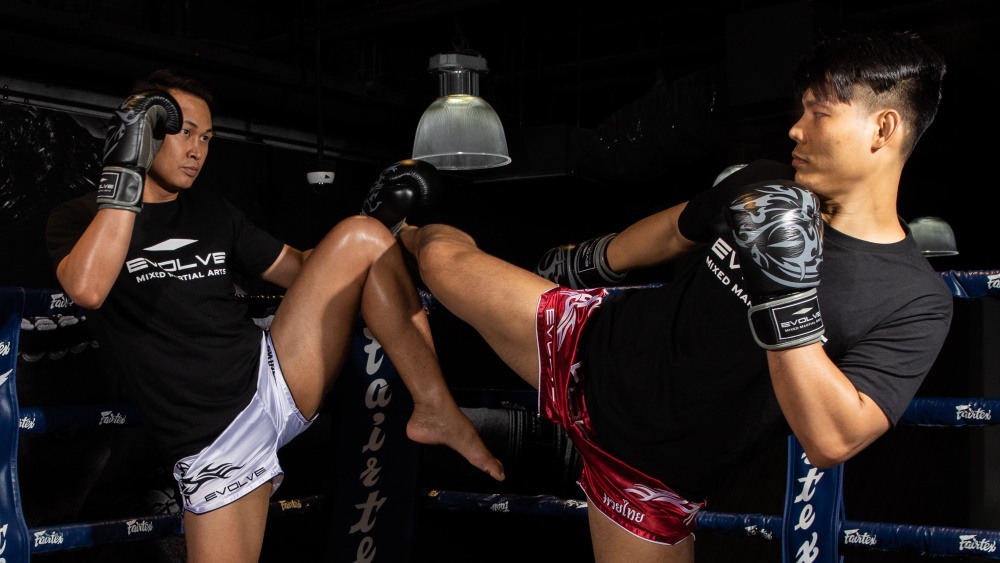
The shin block is one of the first defensive techniques many Muay Thai students learn. It is used to block low kicks, one of the most used attacks in Muay Thai competitions. The shin block is also used to block roundhouse kicks to the torso. It’s a simple technique to master, so even beginners can start using it immediately.
The technique can be performed with your lead or rear leg, based on the attack’s direction.
Here’s how you perform a shin block when your opponent throws a low kick at you:
- From your fighting stance, bring your knee up until it is slightly inside your elbow. Your elbows should be close to your body.
- Turn your hips, so your shin is facing at a 45-degree angle away from you.
- Raise your knee as high as you need so that your opponent’s kick lands in the middle of your shin.
- Don’t bend your torso while performing this technique. You want to remain as upright as possible. Drill this technique relentlessly until it becomes something you naturally do when a low or body kick is thrown at you.
2) Covering Up
The “see no evil, hear no evil, speak no evil” blocks in Muay Thai are simple cover-up defenses that protect different head levels from strikes while sacrificing some vision and countering ability.
- See No Evil: This is the most basic blocking technique for defending against punches and elbows. You simply bring your gloves to your face and keep your elbows close. It’s a rudimentary blocking technique that significantly reduces your ability to counter your opponent’s strikes or even see where they are coming from. Still, it’s an effective way to defend against straight punches, uppercuts, and elbows aimed at the front of your head.
- Hear No Evil: This is the basic covering-up technique for blocking hooks and other swinging attacks aimed at your head. It can even be used to defend against roundhouse kicks to the face, but instructors typically don’t recommend it since the force behind such kicks can still be enough to cause a knockout or break an arm even when it’s blocked. You simply bring your gloves to your ears to use this blocking technique and keep your elbows tight. It also limits your ability to counter, but not as much as covering up your face does. It’s an effective way to stop attacks that target the side of your face, like hooks or horizontal elbows.
- Speak No Evil: This blocking technique is used to defend against attacks that target your jaw and other attacks to the top half of your torso. To use this block, bring your hands to your face to cover your mouth and keep your elbows close and tight. It gives you more opportunities to counter than the two other blocking techniques discussed above since your movement and vision aren’t restricted. You can still see attacks coming, and you can quickly move your head away from the centerline in this position.
“See no evil, hear no evil, speak no evil” is a popular saying in many Muay Thai and boxing gyms. It is used to teach students the basics of covering up.
3) Elbow Block
Muay Thai fighters block punches and kicks to their body with their elbows. It’s a simple blocking technique to learn. From your fighting stance, you bring your elbow downward to shield that side of your body. You can bend at the torso using this block.
A cool thing about blocking body shows with your elbows is it puts you in an excellent position to counter using the same arm. The key is to fire off the counter as soon as your opponent’s attack touches your elbows. That way, you catch them while they’re still bringing their hand back to protect their face. You can counter with a straight, uppercut, or hook.
4) Double Forearm Block
The double forearm block is a valuable defensive technique that takes a lot of power off straights, hooks, uppercuts, and elbows. There’s not much to it; you simply bring both arms to your face horizontally. Some fighters like to transition into it from the long guard.
The double forearm block also serves as an entry point for clinch positions. It keeps you moderately protected while you close the distance on your opponent. The double forearm block can also be used to protect your body against punches and kicks. Just keep in mind that bringing both arms to your body leaves your head extremely vulnerable. A savvy opponent might feint just to get you to drop both hands towards your body before firing a powerful shot to your head.
5) The Foot Block
This is a more advanced blocking technique, but it’s an effective way to stop an opponent’s kick before it gains momentum. The technique can also be used to stop knee strikes. It involves using your heel to stop the forward momentum of an opponent’s thigh, knee, or foot as they throw a strike at you.
To execute the block, you simply perform a push kick on your opponent’s thigh, foot, or knee as they start throwing a kick. The thighs are typically the biggest target, so most fighters aim for them. The point of this block is to impede the progress of your opponent’s leg as they throw a kick. This technique will often leave your opponents off-balance, so follow through with some offense while they’re compromised.
Frequently Asked Questions About Muay Thai Blocking Techniques
Q: Why Is Blocking Important In Muay Thai When Slipping And Evasion Are Also Options?
A: Blocking, slipping, and evasion are all elements of a complete defensive system, and none of them replaces the others. Evasion — footwork, head movement, and angle changes — is the ideal first line of defence because it removes you from the attack without any contact. Blocking is necessary for situations where evasion is not possible: when you are in close range and cannot create space, when an attack comes faster than you can slip, or when you are against the ropes with limited movement options. A fighter who relies solely on evasion will eventually be caught in a position where they cannot move, with no blocking habits to fall back on. A fighter with strong blocking habits always has a defensive option available, regardless of their position in the ring.
Q: What Is The Most Important Blocking Technique For Beginners To Master First?
A: The shin block is the highest-priority blocking technique for most beginners, for two reasons. First, low kicks and body kicks are among the most frequently used and most damaging attacks in Muay Thai — both in competitive contexts and in sparring, so the need to defend against them arises constantly from the earliest stages of training. Second, the consequences of not checking kicks are immediately and painfully obvious: accumulated leg damage significantly impairs a fighter’s mobility, balance, and confidence in a way that no other unblocked attack does as consistently. Developing the shin block early and drilling it to automaticity protects your training longevity and builds the habit of responding to incoming kicks before they become a liability.
Q: How do I Know Which Covering-Up Variation To Use In A Real Exchange?
A: Ideally, the covering-up variation you use is determined by the direction and type of incoming strike — see no evil for straight attacks coming from the front, hear no evil for hooks and horizontal attacks coming from the sides, speak no evil for attacks targeting the jaw and upper torso when you need to maintain vision. In practice, particularly for beginners, the speed of real exchanges often means that conscious selection between variations is not realistic. The solution is to drill each variation against the specific attack type it defends until the match-up becomes automatic — so that the reflex to bring the hands to the ears fires in response to a hook, and the reflex to bring the hands to the face fires in response to a straight, without conscious decision-making in the moment. Partner drilling where the attacker calls or signals their strike type before throwing, is an effective way to build this automatic mapping.
Q: Why Does The Elbow Block Create A Counter Opportunity And How Do I Develop That Response?
A: When you drop your elbow to block a body punch or kick, your opponent’s striking hand or foot is momentarily at your elbow — and then must travel back to their guard before they can protect their face. The counter window that opens is the fraction of a second between the strike touching your elbow and the hand returning to position. Developing the reflex to fire a counter in that window — a straight, uppercut, or hook with the same arm that blocked — requires drilling the block-and-counter as a single sequence rather than two separate actions. Partner drilling, where the training partner repeatedly throws body punches, and you practise the elbow block followed immediately by a counter, is the most direct way to build this. Over time, the counter becomes automatic — as soon as the block fires, the counter follows without a conscious instruction.
Q: What Are The Limitations Of The Double Forearm Block And How Do I Avoid Being Caught By Feints?
A: The double forearm block’s primary limitation is that it fully occupies both arms, leaving the head completely unprotected from any attack that gets through, over, or around the block. A savvy opponent who recognises that you are using this block will feint to the body to draw both arms down before throwing a head strike. The most effective counter to this exploitation is to use the double forearm block sparingly and situationally — as a clinch entry tool or a temporary shield against a specific combination — rather than as a sustained defensive position. When you do use it, your footwork and movement should be active simultaneously, so that you are not a stationary target for the feint-to-head sequence. Reading your opponent’s feint patterns in sparring is the specific skill that reduces vulnerability to this exploitation.
Q: How Does The Foot Block Differ From The Shin Block And When Should I Use Each?
A: The shin block is a reactive defensive technique — it fires in response to an incoming kick that is already on its way, intercepting the strike mid-flight with the shin to absorb and redirect the impact. The foot block is a proactive technique — it fires before the opponent’s kick gains full momentum, targeting their thigh, knee, or foot at the point where the kick is still loading, using a push kick motion to stop the attack before it develops into a fully powered strike. The shin block is used against kicks that are already committed and moving; the foot block is used against kicks that are just beginning. The foot block requires reading the opponent’s kicking intention early enough to intercept the leg before it has built speed — a timing skill that develops with experience. In practical terms, the shin block is used more frequently because it defends against already-launched attacks, while the foot block is a more advanced tool used by fighters who have developed the ability to read early attack signals.
Q: How Do I Build Blocking Habits That Work Under Pressure In Sparring?
A: Blocking habits develop through progressive, deliberate exposure — starting with cooperative partner drilling where the attacker signals or calls their strike before throwing, and gradually increasing the speed and unpredictability of the attack as the defensive response becomes more automatic. Simply sparring and hoping the blocks appear is less effective than structured drilling because it does not isolate the specific stimulus-response pairing — attack type to block type — that needs to become automatic. At a gym like Evolve MMA in Singapore, structured pad and partner drills specifically designed to build defensive reflexes alongside offensive ones give practitioners the most efficient path to blocking habits that hold up under real sparring pressure. The key is to introduce each blocking technique in isolation first, make it automatic against its specific attack, and then integrate it into broader sparring where multiple attack types and combinations require the full defensive toolkit.
Q: Can These Blocking Techniques Be Used In MMA And Self-Defense As Well As Muay Thai?
A: Yes — all five techniques translate directly to both MMA and self-defence contexts. In MMA, the primary adaptation is awareness of the grappling dimension: covering up with the see no evil or hear no evil position while against the cage, for example, can be followed by a clinch and takedown attempt by an opponent. This does not change the blocking technique itself but affects the footwork and movement decisions that accompany it. In self-defence, the covering-up variations and the elbow body block are immediately applicable without any modification — they require no equipment, no specific training environment, and work against the untrained attacks most likely to be encountered outside a gym. The shin block, while highly effective, requires conditioning of the shin that takes time to develop — a fact worth bearing in mind when considering its self-defence application.
Final Thoughts
Blocking is not a passive activity in Muay Thai — it is the first action in a sequence that should end with a counter. Every shin block that checks a kick creates a moment of off-balance. Every elbow block of a body shot positions you for an immediate counter with the same arm. Every covering-up variation that absorbs a combination gives you the fraction of a second where your opponent’s hands are returning to guard and their chin is briefly exposed. The fighters who understand this — who drill their blocks with the counter built in from the start — turn their defence into one of their most dangerous offensive tools.
Master the five blocks in this article. Drill each one against the specific attack it defends until the response is automatic. Then build the counters that follow each block until those are automatic too. The result is a defensive game that does not just protect you — it actively punishes every opponent who throws at you, which is exactly what Muay Thai’s best defensive fighters have always done.
You may also like:
The Complete Guide To The Muay Thai Push Kick